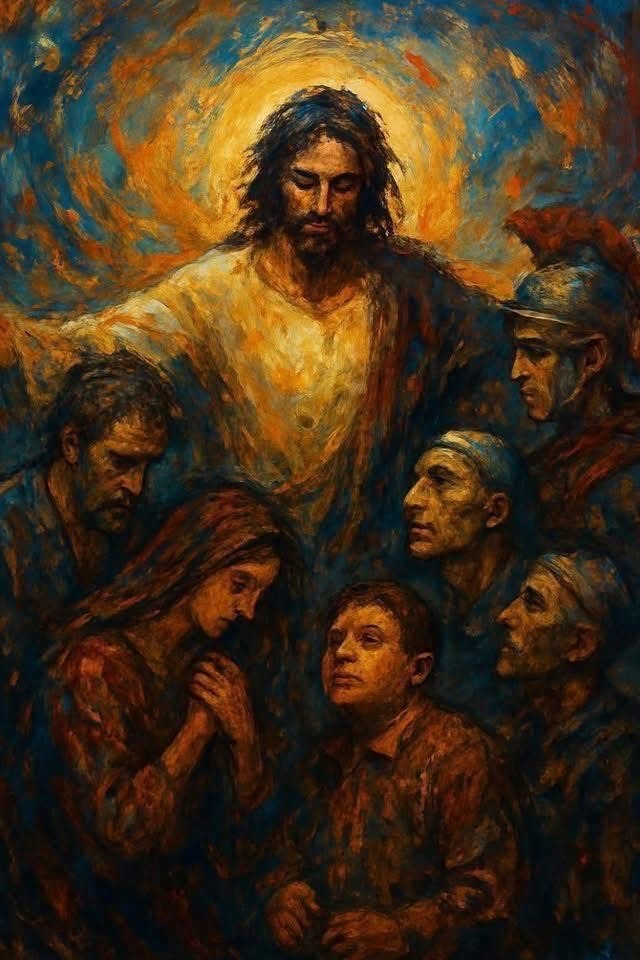
The Gospel of the Wild Messiah

Mark’s gospel reveals an interesting exchange between Jesus and his disciples. This is how he writes it:

“Jesus went on with his disciples to the villages of Caesarea Philippi, and on the way he asked his disciples, “Who do people say that I am?” 28 And they answered him, “John the Baptist; and others, Elijah; and still others, one of the prophets.” 29 He asked them, “But who do you say that I am?” Peter answered him, “You are the Messiah.” (Mark 8:27-29).

“Who do the people say that I am?” It seems a rather benign question on the surface. I mean, it’s not as though Jesus hasn’t explained it, lived it, preached and taught it, performed it. Dig a little deeper though and I think we get to the purpose for his question. Anyone could ask a similar question and receive all manner of different responses.

“Oh, he’s so reliable.”

“She’s the sweetest person we know.”

“He’s not to be trusted.”

Jesus was hip to the notion that we are all deeply kaleidoscopic in our essence. Multi-faceted and gloriously chaotic. He was also deeply aware of how easy it is to build a picture of someone on the basis of preconceived ideas, expectations, hopes and dreams, and, especially, one’s personal-cultural lens.

Perhaps the most coopted, controlled, coordinated, compared, and quieted person in history is Jesus of Nazareth. Hang around social media and almost any news source for very long and it becomes immediately apparent that Jesus is everyone’s mascot, lap-dog, meme; he’s the picture on everyone’s individual flag of identity. “We have the real Jesus. They do not.” All of which fail miserably to actually answer Jesus’ question.

Knowing this and with an interest to dig into Jesus more rigorously, more honestly, St James Scottish Episcopal Church in Leith, where we attend and serve, has adopted as its Lenten theme this year: The Gospel of the Wild Messiah. Our aim is to seek out and walk alongside the Jesus we encounter in scripture, in the marketplace, on the margins, in our lives. A wild and prophetic character perfectly embodying love, truth and power.

The following poem by Reverend Jon Swales is our shared meditation. Will you join us as we pursue the untamed, undomesticated Jesus?

The Gospel of the Wild Messiah

He did not come
robed in safety.

He did not come
crowned in gold.

He came
with dust on his sandals,
blood in his future,
and fire in his bones.

Not to keep the peace—
but to break it open.

The penniless preacher
from Nazareth
walks towards the pain,
kneels
where no king kneels,
calls friends
what the world calls waste.

The mission
of the wild messiah
is
madness to the market
and
mercy to the margins.

Here is a man.
Exiled flesh.
Olive skin
cracked
like parched land.

No one hugs lepers.
But he does.
No ritual.
Just reach.

Let the church be like this—
touching
what others avoid.

Body of Christ,
move your hands.

Here is a man.
Dropped
through a broken roof.

They say
his legs are cursed,
but Jesus says,
“Friend.”

Forgiveness
before healing.
Wholeness
before walking.

Let the church be like this—
tearing open ceilings
so mercy
can get in.

Here is a man.
Sworn to Caesar.
A soldier’s posture,
a servant’s pain.

Faith speaks
from strange lips.
Jesus listens.
Heals.

Let the church be like this—
wide-lunged enough
to breathe in
foreign hope.

Here is a woman.
Tears on feet,
perfume in air,
shame in the room.

They call her sinner.
He calls her forgiven.

Let the church be like this—
welcoming the shamed.
Less pointing.
More tears.
Less tally.

Here is a man.
Naked in tombs.
Self-harm
scrawled across skin.

Unclean,
unkempt,
unloved.

Jesus asks one thing:
What’s your name?

And the demons
tremble.

Let the church be like this—
naming the silenced,
holding the haunted.

Here is a woman.
Twelve years of blood.
Invisible
in a crowd.

She dares a touch—
and it stops him.

He says:
“Daughter.”

A word that heals
more
than wounds.

Let the church be like this—
interruptible.
Alive to power
in the unnoticed.

Here is a man.
Short in stature,
tall in corruption.

Collaboration money
stacked
in a crooked house.

Jesus invites himself in.
No lecture.
Just presence.

And something
changes.

Let the church be like this—
hosting grace
before repentance,
feasting
with the fallen.

Here is a man.
Blind
and begging.

Shouting louder
than the crowd’s comfort.

Jesus halts.
Sees
what others pass by.
And lets light in.

Let the church be like this—
attentive
to inconvenient cries.

This is not
a clean gospel.

It smells
of spit and soil,
rupture
and resistance.

It weeps
in alleyways
and whispers
beside beds.

It eats
with the wrong people
and sings
in the dark.

The kingdom
is not far.

It is falling
like a tear
from the face of God.

And still
he walks.

Still
he calls.

Still
he touches
the untouchable
and invites
the forgotten home.

Let the church
be like this.

Let us be
wounded,
wild,
and faithful.

Amen.
And amen again.

My Gingerbread Church

I’ve not been especially active on this site for awhile. You know how it is with poets. Feast or famine. Self-aggrandisement one minute. Self-loathing the next. Ah well…

Therefore, I felt it a good way to break this space open once more, not with one of mine, but with a surprisingly tasty piece written by a young friend, Ruth. She is as intelligent as she is effervescent.

Please enjoy her words as I have. Perhaps have someone read it out loud to you while you sip mulled wine and let Ruth’s words warm you. I give you “My Gingerbread Church” by Ruth Quill.

_____________________________________________________________________________

My Gingerbread Church

At 11 John’s Place, a gingerbread house is under construction.

The pathway paved with after eights, garden filled with candy canes.

The porch a little crumbly, entrance, two gingerbread slabs 

leaned against each other like a pointed hat.

A gingerbread ramp with chocolate finger railings,

liquorice door frames and jelly beans for handles.

A tube of icing to cement the jellied toilets to the floor,

a gingerbread roof sprinkled with hundreds and thousands.

There are jelly babies crying in the back room,

but our lullabies are full because we know what’s coming.

Jonathan snores and clarinet hums, samba drums and tap drums,

young shepherds and wise men, holy screams of labour.

Let’s build a gingerbread altar for him, bejewelled with smarties.

Let’s hang a gingerbread mobile from the ceiling.

Let’s light a gingerbread candle and watch it burn down till the special day,

when we’ll hand out gingerbread on the door, inscribed in royal icing

with liturgies and scripture, and then snap it in two,

and dunk one half into those brilliant cups of tea,

and eat it, soft and sweet, broken for us, broken for all.

_______________________________________________________________________________________

Ruth is a Scottish poet and freelance programmer based in Leith. Her writing is often inspired by childhood whimsy and play.

By Whichever Wind

For whatever reason, I don’t post here much these days. Lack of inspiration? Maybe, a little. Laziness or neglect? Perhaps, a little. Distracted by other things? Sure, a little.

So, when inspiration comes, it rests on me to act upon it. That inspiration comes by way of this rather evocative piece by Hong Kong poet, Sean Kwok, now relocated to the Scottish Borders. It can be found in the 2024 edition from The Scottish Book Trust entitled: Hope. Contributions feature stories, anecdotes, and poetry highlighting elements of hope. I share the author’s note below in that regard:

I was fortunate enough to have relocated from Hong Kong to the Scottish Borders exactly at a time of political turmoil in my home city. Then the pandemic engulfed the world. When I stopped on a walk on a rather windy day, I made a connection with the wind. It was of course the wind that accompanied my flight to Scotland; so too were the ‘winds’ of historical circumstances and perhaps even a coincidence of timing. I felt guilty for having to abandon my old home and did not readily embrace my new home, yet despit the lockdown, fellow Borderers have generously befriended me. I saw that the idea of home need not be tied to land boundaries but can simply come from the heart, strengthened by connections between people, wherever we come from and wherever we shall go. The transformative aspect of home, like wind, renews my hope that humans can forge better days for each other.

It is with pride I share here his poetic ruminations on the same.

By Whichever Wind

Why do we keep moving, every generation a restless hand?

Some came by boat, others spirited by waters alone.

They kept their heads low; the skies took to our land

and made us whisper their parting promise.

I went atop the winds of fate

predicated by history and always

doubting, an island of distress

too busy casting the flag of freedom to the flame

than to see me go, as if to dry our tears.

I crossed the oceans of a thousand fears,

embracing neither pride nor pain

as I switch to a higher address.

Too accustomed to the ruins of a home away;

too much paperwork on our petite plate.

Memory serves as a chalice untouched by day

yet as infectious as a laugh in duress.

I felt the peace of night a lifetime’s gain

won by those I failed to offer but a voiceless cheer.

But there is more I can claim as my ain

as I find others who have been oppressed no less

by the walls of their house and still take time to play.

To the tune of the Tweed, you vow to confess

surprise at ever sunset, to bear an open heart again.

By whicher wind, you’ve carried your truth and let me fly mine

for both homes share the borders of my heart.

Wherever and wherefore I came and am to go,

I promise to follow the winds of life,

for nothing is more undecided,

than whatever our tomorrows would bring.

And we have much we can do together.

November – A Poem a Day Challenge

I don’t write much poetry these days. Partly a lack of inspiration. Partly laziness. Partly a narrower life hallway not as friendly to poetry construction. Okay, mainly laziness. Good friend and fellow poet, Kelly Belmonte over at All Nine (please do check out her wonderful stuff!) has thrown down the gauntlet, literarily speaking. She’s has taken up the challenge to post a poem a day, or at least, a number of times throughout November.

Dearest Kelly, I take up that challenge. I do so in the simplest possible manner: Haiku. Nineteen syllables more than the ridiculously long stretch of dry, poetry-less crickets from me of late!

So, here goes.

Day 1

November

I saw what November press’d

against her bosom –

Spring, wrapped up tight in Winter.

Sometimes

Sometimes a poem works well enough to post again…sometimes.

robertalanrife's avatarRob's Lit-Bits

Sometimes the drops of air laugh at our impudent chuckle

and gather themselves into a breath. Sometimes


when the robin stares too long at the kitchen window,

we become her careless dream. Sometimes


the patches of nothing between the rain

know something, too, of waiting. Sometimes


I pinch myself asleep long enough to awaken again

to the resurrection of your scent. Sometimes


the sucking sound when pulling boots up from the mud 
is how I hear your leaving. Sometimes


the one goose not in formation with the others, 
heading where life goes are my thoughts without you. Sometimes


like old leaves pasted back on the living tree 
is the sound of my cracked voice next to your song. Sometimes

 
like a shower in the lobby with the door open 
is our talk. Sometimes


in the wordless poetry, alone,

is our silence.


View original post

The Moorland Fairies

After having a conversation about “old school” vs “contemporary” poetry with a young student in the middle of a Master’s degree in Comparative Literature, I thought this one might be a good one to repost. In honour of “old school”…

robertalanrife's avatarRob's Lit-Bits

The folklore of the Scottish highland moors is extensive and, frankly, creepy as hell. This is a poem that narrates some of that creepiness. Enjoy…or whatever one does with this kind of poetry!

 Moorland Fairies

From marsh and hill through woodland, still,

arose the lithe-limb’d people.

Their frozen stare could nearly kill

e’en those under God’s steeple.

* * *

For many years they haunted men

and frightened little children.

They came at night from eerie dens

to poison, scare or steal them.

* * *

Hunted down with bow and gun

till all were tired and hopeless,

till one cold day, they came upon

a creature in death’s caress.

* * *

So pale and wan, it lay atop

a thicket, robed in grasses;

it’s bluish skin, stout hearts could stop

black eyes, like coal-molasses.

* * *

The men bent down to prod and stare,

its spindly shanks to…

View original post 178 more words