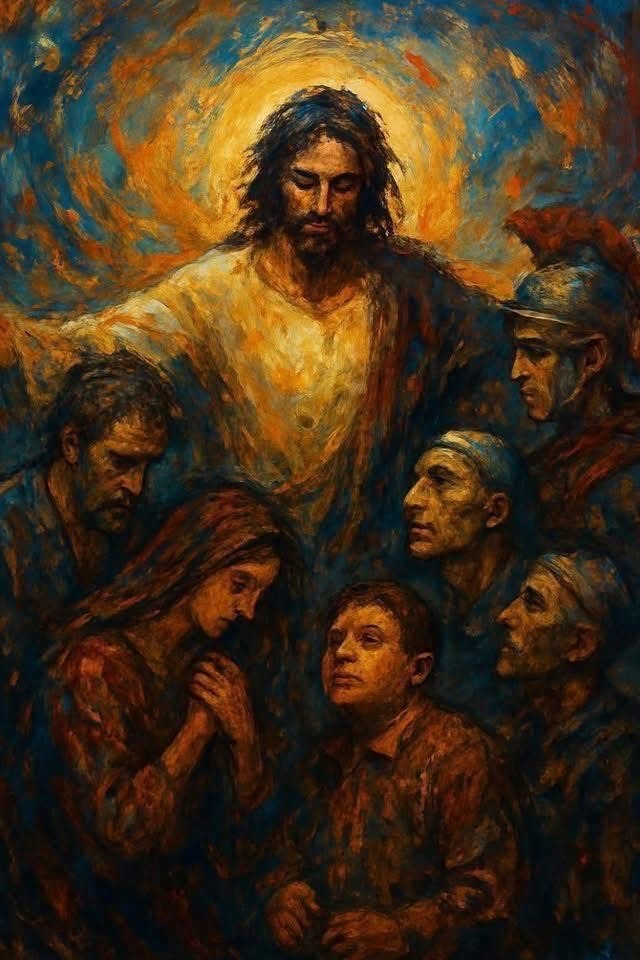
The Gospel of the Wild Messiah

Mark’s gospel reveals an interesting exchange between Jesus and his disciples. This is how he writes it:

“Jesus went on with his disciples to the villages of Caesarea Philippi, and on the way he asked his disciples, “Who do people say that I am?” 28 And they answered him, “John the Baptist; and others, Elijah; and still others, one of the prophets.” 29 He asked them, “But who do you say that I am?” Peter answered him, “You are the Messiah.” (Mark 8:27-29).

“Who do the people say that I am?” It seems a rather benign question on the surface. I mean, it’s not as though Jesus hasn’t explained it, lived it, preached and taught it, performed it. Dig a little deeper though and I think we get to the purpose for his question. Anyone could ask a similar question and receive all manner of different responses.

“Oh, he’s so reliable.”

“She’s the sweetest person we know.”

“He’s not to be trusted.”

Jesus was hip to the notion that we are all deeply kaleidoscopic in our essence. Multi-faceted and gloriously chaotic. He was also deeply aware of how easy it is to build a picture of someone on the basis of preconceived ideas, expectations, hopes and dreams, and, especially, one’s personal-cultural lens.

Perhaps the most coopted, controlled, coordinated, compared, and quieted person in history is Jesus of Nazareth. Hang around social media and almost any news source for very long and it becomes immediately apparent that Jesus is everyone’s mascot, lap-dog, meme; he’s the picture on everyone’s individual flag of identity. “We have the real Jesus. They do not.” All of which fail miserably to actually answer Jesus’ question.

Knowing this and with an interest to dig into Jesus more rigorously, more honestly, St James Scottish Episcopal Church in Leith, where we attend and serve, has adopted as its Lenten theme this year: The Gospel of the Wild Messiah. Our aim is to seek out and walk alongside the Jesus we encounter in scripture, in the marketplace, on the margins, in our lives. A wild and prophetic character perfectly embodying love, truth and power.

The following poem by Reverend Jon Swales is our shared meditation. Will you join us as we pursue the untamed, undomesticated Jesus?

The Gospel of the Wild Messiah

He did not come
robed in safety.

He did not come
crowned in gold.

He came
with dust on his sandals,
blood in his future,
and fire in his bones.

Not to keep the peace—
but to break it open.

The penniless preacher
from Nazareth
walks towards the pain,
kneels
where no king kneels,
calls friends
what the world calls waste.

The mission
of the wild messiah
is
madness to the market
and
mercy to the margins.

Here is a man.
Exiled flesh.
Olive skin
cracked
like parched land.

No one hugs lepers.
But he does.
No ritual.
Just reach.

Let the church be like this—
touching
what others avoid.

Body of Christ,
move your hands.

Here is a man.
Dropped
through a broken roof.

They say
his legs are cursed,
but Jesus says,
“Friend.”

Forgiveness
before healing.
Wholeness
before walking.

Let the church be like this—
tearing open ceilings
so mercy
can get in.

Here is a man.
Sworn to Caesar.
A soldier’s posture,
a servant’s pain.

Faith speaks
from strange lips.
Jesus listens.
Heals.

Let the church be like this—
wide-lunged enough
to breathe in
foreign hope.

Here is a woman.
Tears on feet,
perfume in air,
shame in the room.

They call her sinner.
He calls her forgiven.

Let the church be like this—
welcoming the shamed.
Less pointing.
More tears.
Less tally.

Here is a man.
Naked in tombs.
Self-harm
scrawled across skin.

Unclean,
unkempt,
unloved.

Jesus asks one thing:
What’s your name?

And the demons
tremble.

Let the church be like this—
naming the silenced,
holding the haunted.

Here is a woman.
Twelve years of blood.
Invisible
in a crowd.

She dares a touch—
and it stops him.

He says:
“Daughter.”

A word that heals
more
than wounds.

Let the church be like this—
interruptible.
Alive to power
in the unnoticed.

Here is a man.
Short in stature,
tall in corruption.

Collaboration money
stacked
in a crooked house.

Jesus invites himself in.
No lecture.
Just presence.

And something
changes.

Let the church be like this—
hosting grace
before repentance,
feasting
with the fallen.

Here is a man.
Blind
and begging.

Shouting louder
than the crowd’s comfort.

Jesus halts.
Sees
what others pass by.
And lets light in.

Let the church be like this—
attentive
to inconvenient cries.

This is not
a clean gospel.

It smells
of spit and soil,
rupture
and resistance.

It weeps
in alleyways
and whispers
beside beds.

It eats
with the wrong people
and sings
in the dark.

The kingdom
is not far.

It is falling
like a tear
from the face of God.

And still
he walks.

Still
he calls.

Still
he touches
the untouchable
and invites
the forgotten home.

Let the church
be like this.

Let us be
wounded,
wild,
and faithful.

Amen.
And amen again.

Death’s death

Death’s death

Live! Live! Not one minute

more to solemnize the squaring truths

of the dark, exasperating. Exsanguinating.

The probing luminant, juggernaut

of dawn brought down as a quickening

shade of brilliance over the tar-black,

songless night – now gasping out

its own greying reminiscence.

Kicking against the goads, a denouement

of despair, decay’s quietus comes to mock.

But its voice is too dry now for anything more

than the androgynous whisper of a skeleton.

The bones rattle and try in vain to spark, to scare,

to survive the day, already here.

Death, this needy after-thought, this choking

wheeze of duskish, tight-lipp’d groaning –

it can no longer hunt, its legs are

broken, a dislocated shoulder no longer

suited to hefting hopelessness.

Spring! Spring! O antediluvian Spring! How

many are your salted children, lined up

outside your garden wall. Someone

has unchink’d the tangled gate and trodden new

footprints – fresh, ancient and deep – in the Virgin soil.

We come too, having hid ourselves in

the wisp of your blood-colour’d sleeves.

Droughted, now, a tomb and the perfect surprise:

breaths in lungs once shut, re-sighted eyes,

and in the first of all new hours,

Someone has made light work of death.

After the tomb

When blood, still damp, soaked through

the sleeves of shrug-shoulder’d men,

did you cry for their laughter?

Were your accusers held in sleep

when Mary’s shaking hands

held fast your plundered feet?

How long before bewildered men

and doting women find again

their reasons for remonstrance?

Will a miracle suffice

to fill the gaps in minds too young

not to lust for proof?

Were the angels surprised

to find their silenced songs

reignited for their fittest subject?

Did you know these walls would

only remind you of this one, unending breath?

This one effortless act for one so bored of death?

Triduum Words – Saturday

saturday

a day, laid out to flay and scandalize,

reserved for a more macabre affair

some spikes, some wood,

some dereliction of hope, one cosmic corpse

and in these longest of all hours

lay light itself

without so much as a yawn

the skies, now silent and spent

the skies, now silent and spent

review their own sorry past

for all hope has fled

replaced by the wordless song

of a dead friend

Painting by Wayne Haag

Triduum Words – Good Friday

Before God’s last laugh of resurrection, in order to lean more deeply into the narrative of these three days (tri-duum) of promises, communion, mandates of love, betrayal, miscarriage of justice, ignoble death, hollow silence, and dashed hopes, I’ll be posting poetry for each day: Maundy Thursday, “Good” Friday, and Holy Saturday.

Today is called, ironically, “Good” Friday. Obviously, a name given well after-the-fact since no one alive during those days would likely have called it such. Even a quick Google search produced this: “The earliest known use of the term “Good Friday” is found in the South English Legendary, a text from around 1290, where it is written as “guode friday”. While the exact origin is debated, the Oxford English Dictionary (OED) cites this as the earliest evidence.”

However, we have the benefit now of two thousand years of hindsight and written accounts from which to backwards engineer the stunning events of that day. What was macabre became for us something much, much more. Something…good. 

What sounds are these…?

What sounds are these I hear

of sobs and sighing, seering pain of doubt.

If leaves could talk what might they say

of a crying God, a hopeful hopelessness wrapped in trust?

* * *

Raked across an endless heart,

the bursting bastions of familial love

come couched in terms of unsteady prayers, yearning, yet wavering.

One, two, three faltering steps toward full submission to…what?

* * *

“Must it be this way? Must this broken sentence require my full stop?

Let it be but a misstep, a simple error in divine judgment, and a world

hurled into disarray is called back again.

Must you kiss away their pain with my blood on your lips?”

* * *

Daylight friends become nighttime strangers.

Eyelids, heavy with grief, fear and confusion

flutter and fail. Closed and unseeing they become

when sharp and sure is needed most.

* * *

Gruff and groping they march,

crashing through grass, garden and grove,

sniffing and snorting with dark and heavy purpose.

A poisoned kiss stops cold their treading, hateful boots.

* * *

Two cold lips meet two warm cheeks.

Foe, one time friend, greets friend of all foes

and the world holds its breath –

pausing hell’s raucous revelry and heaven’s sonorous singing.

* * *

Ponderous parade of an army and shackled lamb

whisks down backroads to audience with puppets and clowns,

whose dirty, back-room deals deal out kangaroo justice,

promising the untimely sham of caustic, casual connivances.

* * *

Spewing, spitting, spluttering out lies,

the venom of their dalliance denies all place for truth.

And a king receives a pauper’s sentence.

And a pauper refuses a king’s ransom.

* * *

The dam of reason well collapsed

and the hammer of hate posing as justice

falls as teeth, claws and fangs bite deep

tearing open his back. Men flay the skin of God.

* * *

He is dressed in the accoutrements of power

the punch-line of sparring, jousting jokes

fit for fools, bullies and frightened little boys

with big fists and a caged bird.

* * *

His walk of shame, will soon regale his fame

and repeal the petty finagling of men, insane with lust

for blood, and bone and sating their angry palettes

on the sight of sorry sacrifice.

* * *

Bones meant for healing and holding faces in tender embrace

part for fiercer spikes, a government’s answer

to the unanswerable questions posed by a hated God,

whose broken feet stay secured to the place of their forgiveness.

* * *

Now begins, indeed, a most sinister work.

An only child, spurned by a doting Father scorns

the unsearchable pain of eternal loneliness that supercedes

a lesser pain: political torture by tiny men.

* * *

The uncertain winter sky belches forth

her mystifying darkness and the once joyous birdsong

succumbs to a silence, infinitely louder,

dripping with the shame of what shouldn’t have needed to happen.

* * *

Time’s bullseye is set in its fitting of that heaving breast,

gasping for breath, groping for a sorry excuse for waning life.

But oh, what shines forth from such battered spirit:

the alchemy of grace, a gavel strikes with love.

* * *

“It is finished” – such words, by heaven hitherto unspoken,

hang in the air like molecules of exhaled proclamation:

a deed done means another can begin,

and in 3 words, the world is forever changed.

* * *

Carrion collective circles high above,

the smell of death and forbidden dinner ripe in the air.

They, whoring, hope for bits of flesh, hair and bone,

meal of mangy wing-ed mongrels bent on the efforts of others.

* * *

Not so for this diamond, bloodied, limp and alone.

A poor man’s corpse blesses a rich man’s tomb

and scented linens shroud the face of passion

that, for now at least, lie pristine and still.

* * *

Why should such a tale, so swift, so sorrowful

twist itself into our earthly fabric?

How could such shameful chaos perpetrated by pawns

undo the fickle fate of cowards and kings?

* * *

What sounds are these I hear?

They are the mournful sobs of a Mother,

the shameful cries of deserters,

the longing sighs of the dead…

Triduum Words – Maundy Thursday

Before God’s last laugh of resurrection, in order to lean more deeply into the narrative of these three days (tri-duum) of promises, communion, mandates of love, betrayal, miscarriage of justice, ignoble death, hollow silence, and dashed hopes, I’ll be posting poetry for each day: Maundy Thursday, “Good” Friday, and Holy Saturday.

Today is, of course, Maundy (or “mandate”) Thursday and we find ourselves hidden among the twelve with Jesus at table with freshly-washed feet, the command of love still thick in the air, and imminent threat of betrayal.

Hints in a meal of trouble come

Hints in a meal of trouble come,

while bread, still warm, newly broken

abides, hidden securely between teeth

in mouths hungry for more.

Hunger assuaged, 24 clean feet and a single, haunted table.

Only crumbs remain,

mixed up and jumbled in pools of spilled wine.

A rumpled table top, tussled

with detritus of a meal, but laughing, flaunting its revelry

through unknowing smiles and the heavy eyelids of sleepy friends.

They restfully recline, sashes loosened,

bits of meat trapped in beards,

but not without gnawing whispers of

“what now?” “What next?” “When?” And in their shared memory

of goodness sense not the coming bad; the storm clouds of betrayal.

An ominous, stealthy breeze sneaks through the room,

slithering past befuddled hearts

and blows its dark breath from one

whose riskless love cannot match he whose riskily painted love,

soon full-flayed and dying, cannot be matched.

Help me to forgive you, God

I recognize this is not the first of its kind. Others have also shared just such things in the wake of the recent, horrific atrocities in Syria. I feel impotent to change much of this. But I can write. And I can pray. Here, I do both. Join me…please.

syria


Lord, they did not ask for dusty feet

sandaled and sore

to walk over the flesh and bones

of neighbors and friends,

of brothers, sisters and parents.

They didn’t ask to be brought before

someone else’s tribunal on imagined

charges of being what they should not be,

what you created them to be.

They did not seek out this desperation

that found them huddled, fearful and crying.

To see the bloated bodies of fellow pilgrims

floating down the river, under bridges,

stuck and floating on rocks jutting out

and shaking bony fists at you for justice,

is to see a God too small to save.

Or am I missing something, Lord?

I am not smart enough to know

the fancy talk at long, important tables

where cigar-smoking men carve up

the world with a wink and a handshake.

I am not wise enough to understand

how to discern what most is needed.

I am not strong enough not to hate,

nor still enough not to stir up

my anger, my outrage.

Lord, if I am forced to sit and watch

what looks like the refuse of hate-filled politics

paraded before a God with weak arms,

and no stomach to move into the fray;

then, help me to forgive you, God,

if only long enough to dive in myself.

Who knows?

Perhaps we’ll meet each other there.

Picture: www.blogs.common.georgetown.edu