
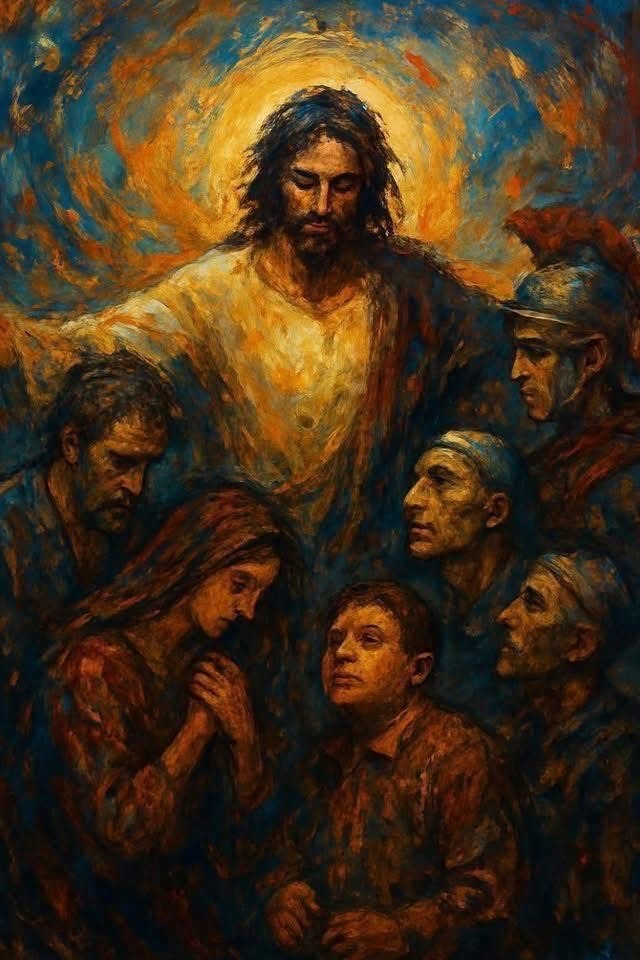
Mark’s gospel reveals an interesting exchange between Jesus and his disciples. This is how he writes it:
“Jesus went on with his disciples to the villages of Caesarea Philippi, and on the way he asked his disciples, “Who do people say that I am?” 28 And they answered him, “John the Baptist; and others, Elijah; and still others, one of the prophets.” 29 He asked them, “But who do you say that I am?” Peter answered him, “You are the Messiah.” (Mark 8:27-29).
“Who do the people say that I am?” It seems a rather benign question on the surface. I mean, it’s not as though Jesus hasn’t explained it, lived it, preached and taught it, performed it. Dig a little deeper though and I think we get to the purpose for his question. Anyone could ask a similar question and receive all manner of different responses.
“Oh, he’s so reliable.”
“She’s the sweetest person we know.”
“He’s not to be trusted.”
Jesus was hip to the notion that we are all deeply kaleidoscopic in our essence. Multi-faceted and gloriously chaotic. He was also deeply aware of how easy it is to build a picture of someone on the basis of preconceived ideas, expectations, hopes and dreams, and, especially, one’s personal-cultural lens.
Perhaps the most coopted, controlled, coordinated, compared, and quieted person in history is Jesus of Nazareth. Hang around social media and almost any news source for very long and it becomes immediately apparent that Jesus is everyone’s mascot, lap-dog, meme; he’s the picture on everyone’s individual flag of identity. “We have the real Jesus. They do not.” All of which fail miserably to actually answer Jesus’ question.
Knowing this and with an interest to dig into Jesus more rigorously, more honestly, St James Scottish Episcopal Church in Leith, where we attend and serve, has adopted as its Lenten theme this year: The Gospel of the Wild Messiah. Our aim is to seek out and walk alongside the Jesus we encounter in scripture, in the marketplace, on the margins, in our lives. A wild and prophetic character perfectly embodying love, truth and power.
The following poem by Reverend Jon Swales is our shared meditation. Will you join us as we pursue the untamed, undomesticated Jesus?
The Gospel of the Wild Messiah
He did not come
robed in safety.
He did not come
crowned in gold.
He came
with dust on his sandals,
blood in his future,
and fire in his bones.
Not to keep the peace—
but to break it open.
The penniless preacher
from Nazareth
walks towards the pain,
kneels
where no king kneels,
calls friends
what the world calls waste.
The mission
of the wild messiah
is
madness to the market
and
mercy to the margins.
Here is a man.
Exiled flesh.
Olive skin
cracked
like parched land.
No one hugs lepers.
But he does.
No ritual.
Just reach.
Let the church be like this—
touching
what others avoid.
Body of Christ,
move your hands.
Here is a man.
Dropped
through a broken roof.
They say
his legs are cursed,
but Jesus says,
“Friend.”
Forgiveness
before healing.
Wholeness
before walking.
Let the church be like this—
tearing open ceilings
so mercy
can get in.
Here is a man.
Sworn to Caesar.
A soldier’s posture,
a servant’s pain.
Faith speaks
from strange lips.
Jesus listens.
Heals.
Let the church be like this—
wide-lunged enough
to breathe in
foreign hope.
Here is a woman.
Tears on feet,
perfume in air,
shame in the room.
They call her sinner.
He calls her forgiven.
Let the church be like this—
welcoming the shamed.
Less pointing.
More tears.
Less tally.
Here is a man.
Naked in tombs.
Self-harm
scrawled across skin.
Unclean,
unkempt,
unloved.
Jesus asks one thing:
What’s your name?
And the demons
tremble.
Let the church be like this—
naming the silenced,
holding the haunted.
Here is a woman.
Twelve years of blood.
Invisible
in a crowd.
She dares a touch—
and it stops him.
He says:
“Daughter.”
A word that heals
more
than wounds.
Let the church be like this—
interruptible.
Alive to power
in the unnoticed.
Here is a man.
Short in stature,
tall in corruption.
Collaboration money
stacked
in a crooked house.
Jesus invites himself in.
No lecture.
Just presence.
And something
changes.
Let the church be like this—
hosting grace
before repentance,
feasting
with the fallen.
Here is a man.
Blind
and begging.
Shouting louder
than the crowd’s comfort.
Jesus halts.
Sees
what others pass by.
And lets light in.
Let the church be like this—
attentive
to inconvenient cries.
This is not
a clean gospel.
It smells
of spit and soil,
rupture
and resistance.
It weeps
in alleyways
and whispers
beside beds.
It eats
with the wrong people
and sings
in the dark.
The kingdom
is not far.
It is falling
like a tear
from the face of God.
And still
he walks.
Still
he calls.
Still
he touches
the untouchable
and invites
the forgotten home.
Let the church
be like this.
Let us be
wounded,
wild,
and faithful.
Amen.
And amen again.
 Rob's Lit-Bits